
Log home and forged fence – how to pair timber with metal
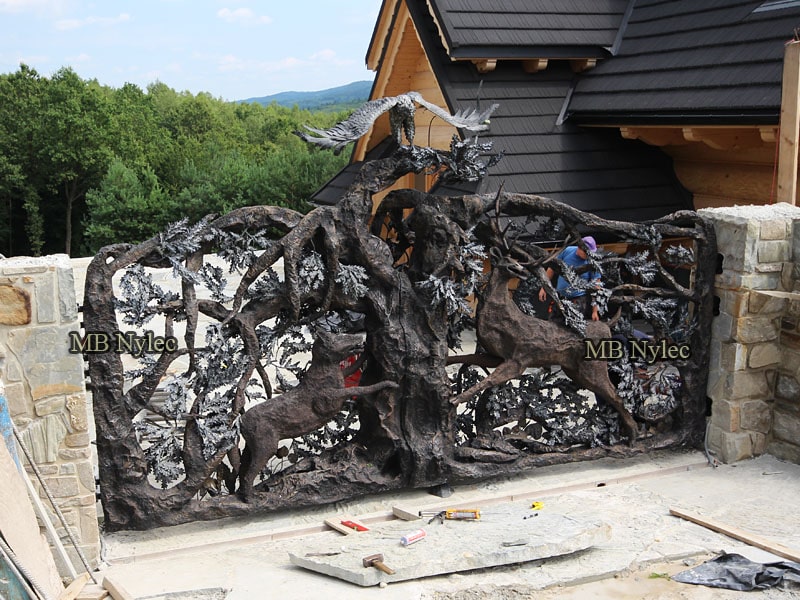
A log home has a character that is hard to imitate. Warm timber, heavy logs and a steep roof make many ordinary fences look out of place beside it. A hand-forged fence can work with it, as long as it is designed from the start around the wood, the stone and the landscape that surround the house.
Nature instead of palace ornament
Next to a log home, motifs taken from its surroundings feel most natural: branches, oak and beech leaves, ears of grain, pine cones, birds and forest animals. Classic scrollwork with volutes and rosettes, so fitting on a manor house, often looks too formal here. Gates in which a tree trunk splits into branches, with a deer or a hunting dog standing between them, look as if they grew up together with the house. We make pieces like these with our own method: trees and animals are forged and shaped by hand, then joined into one structure that works as a gate. More examples are collected among our sculpted gates and fences with forest and hunting scenes.
Not every cabin needs a whole woodland scene, though. Sometimes a simple run of bars with a bark-like texture is enough, or a single branch running across the panel. What matters is a living, irregular metal surface, because a smooth factory profile quickly loses its appeal next to rough-hewn logs. A sense of hierarchy helps too: the driveway gate carries the richest design, the walk gate is quieter, and the fence panels only hint at the motif.
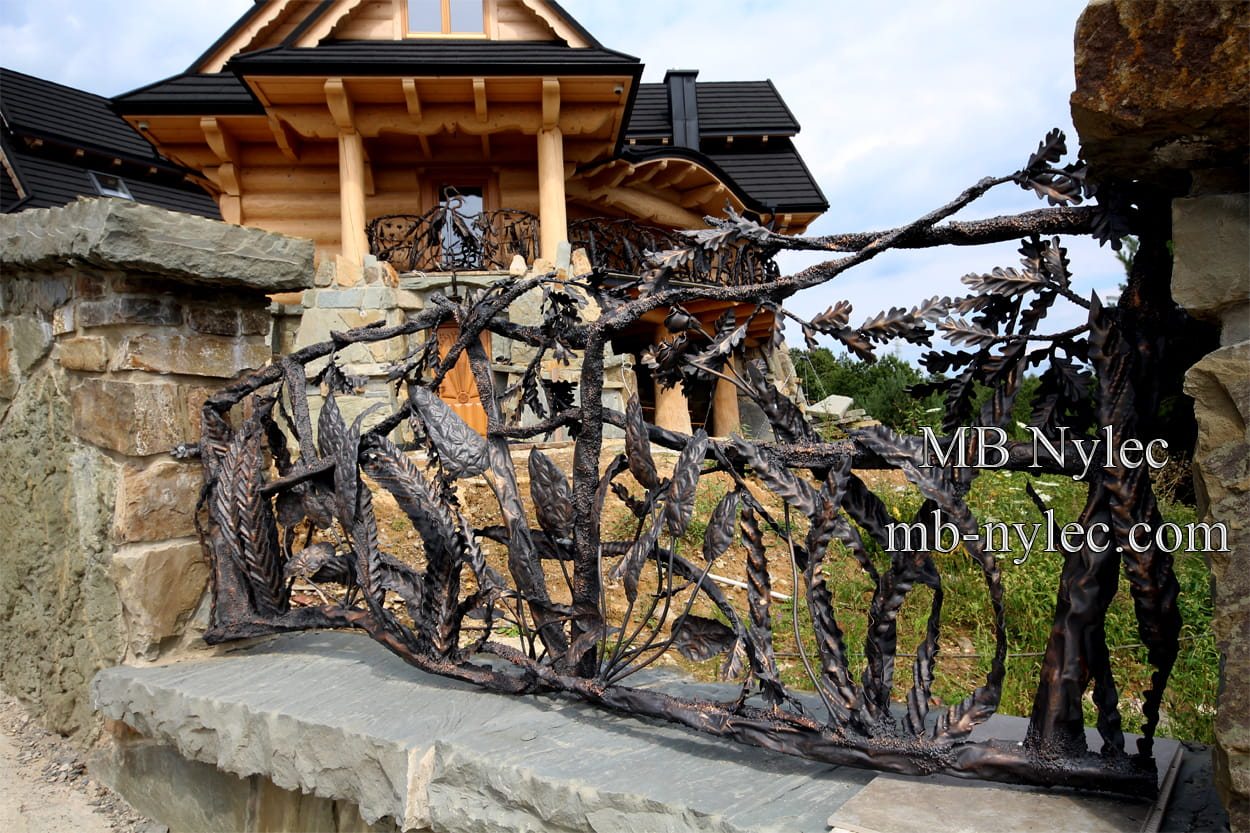
Stone, timber and the color of the metal
Fences around log homes often stand on a fieldstone base or between stone piers. This is a very good backdrop for wrought iron: the stone adds weight and the open panels add lightness. Piers should be designed at the scale of the house. Ones that are too slender disappear beside massive logs, while ones that are too bulky overpower the walk gate and block the view.
The finish is chosen to suit the timber and the roof. Pale, freshly peeled logs look good with dark bronze or graphite, while darker or weathered wood goes well with an old-copper patina that brings out the texture of leaves and bark. Corrosion protection is the same as on any outdoor fence: hot-dip galvanizing and powder coating, with the patina applied as a final decorative layer.
Many log homes are built for the view. An open fence keeps that landscape in sight while still marking the property line clearly. If you need privacy from the road, make the panels denser only along that side and leave them light where the view opens up. We talk through solutions like this with clients when planning wrought iron fences.
Gate, walk gate and the whole property
Around a log home, a consistent style matters more than usual, because the house itself makes such a strong statement. It works best when the driveway gate, the walk gate, the fence panels and the deck railing share one motif. They don’t need to be identical, but they should speak the same language. Lighting deserves a thought as well: a forged lantern with a branch motif, or a wall light on a stone pier, picks out the outline of the gate in the evening and guides guests to the door.
Practical details count too. Log homes are often built in the mountains or at the edge of a forest, where winters bring a lot of snow. Swing gates then need enough clearance above the ground, and a sliding gate needs a track that is easy to clear. On a steep lot the panels are stepped so that each one stays level. Keep in mind that logs move and darken over the years while the metal stays the same, so it pays to choose a fence color slightly darker than the wood on the day the house is finished.
If you are planning a fence for a log home, send us photos of the house and the lot. From them we will suggest a motif, a finish and a panel layout. Designs in many other styles can be found among our custom wrought iron gates.