
Wrought Iron Doors and Door Grilles
We make two kinds of forged doors. The first are full or glazed entry doors for houses, porches, terraces and churches; they have a complex structure, are often insulated and use warm-edge double glazing. The second are openwork door grilles: light, decorative partitions that can be locked and also keep pets in or out.
Like our gates, the doors range from classic designs to full palace entrances, and for churches we make doors with hand-made bronze reliefs.
Our door designs


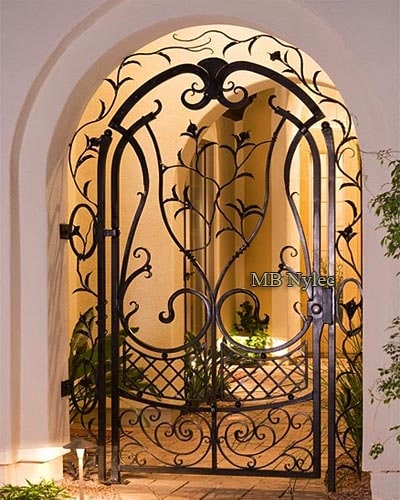


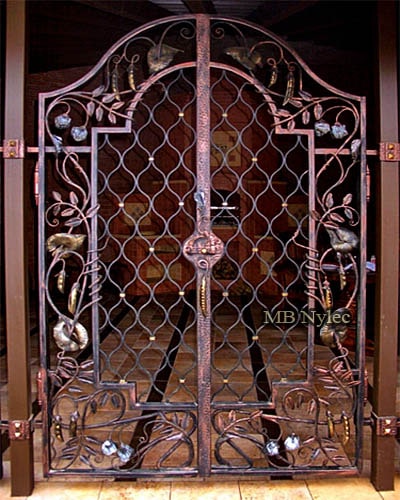


Insulated entry doors that match the house
Our exterior doors combine a forged steel pattern with a thermally insulated core and glazing, so they are as practical as they are beautiful. Ornament can sit outside the glass or inside the sealed unit, where it never needs cleaning.
Doors often share motifs with window grilles, door canopies and the driveway gate, so the whole facade feels designed as one.
Metal doors versus wooden doors
Metal is the most common material for doors worldwide, followed by wood, and both have their strengths. Wooden doors are often associated with luxury, and well-made doors from a good species can indeed be luxurious, but they are much less strong than metal doors. Metal doors sometimes have a less prestigious image, simply because the mass market is full of low-quality doors made as economically as possible.
Metal is an extremely versatile material, though, and it can take forms you would never see in a typical door showroom. A metal door can be a true work of art, far surpassing any wooden door in appearance. Such exclusive doors are made of steel by hand, using traditional forging combined with modern technology, so they are not only beautiful but also highly functional.
Full, glazed or openwork steel doors
Steel doors can be full, with ornament visible from outside and inside and an insulating layer in the core. They can also be made as hinged openwork grilles. Because air passes through them, grilles are not suitable for every use, for example as the only exterior door of a heated building, but they make an excellent entrance to a townhouse courtyard, a second door behind the main entrance, or a decorative partition anywhere inside the house.
The third option is a door with glass. Glass and forged metal look wonderful together; the art lies in joining them strongly and durably. A door can be partly glazed, with glass as an accent and an insulated infill for the rest, or it can be one large moving pane decorated with forged ornament. A forged grille fixed in front of a single pane is attractive and relatively simple, but on a busy street it collects dirt and it is not very warm, because only one pane keeps out the cold.
A better solution is to seal the forged pattern inside the glazing unit, between two large panes, and close it in a decorative frame. The ironwork then never gets dirty, because dust cannot reach it, the door can be cleaned like an ordinary window, and it is much warmer. Doors like this are demanding to make and should be entrusted only to experienced workshops, but the result is the most luxurious door that can be made from any material, a kind of construction you will find only in the most exclusive residences.
Bronze doors
Bronze doors are made mostly for churches, but they are also commissioned for private residences and companies that want to stand out. They are highly exclusive because of the work involved, and the usual technique is artistic metalwork. Bronze is malleable, so it can take many forms that are much harder to achieve in other materials, and a bronze door can look like a large moving sculpture; every one is a work of art, like our bronze church door with Adam and Eve.
Bronze needs no corrosion protection, so the door can keep its natural, noble colour. Over time it may develop a light green patina, a completely natural process that many people treasure; if you prefer to avoid it, the bronze can be sealed. Church doors usually have a timber or steel core, with the bronze used for the ornament and for scenes that can be religious or on any other theme. The scenes are most often reliefs, partly three-dimensional, but we can also make fully three-dimensional sculptures and set them on the door. To keep the work in proportion, the bronze scenes usually decorate only the outside, while the inside carries simpler blacksmith motifs with rivets and forged joints.
Exclusive doors: a monumental entrance
In residential and sacred architecture a door is never just a functional element. It is the first accent that conveys the scale, prestige and character of the building. In this category we make only exclusive forged doors, monumental portals and individually designed doors, often the central, dominant feature of the facade.
When we design a door for a residence, manor, palace or villa, we treat it as part of the facade. Proportions, vertical divisions, the depth of the relief, the weight of the leaf and the surface finish matter as much as the load-bearing structure, and in many projects the door is what gives the building its identity. We make luxurious forged front doors as well as monumental portals several metres high for representative buildings, private residences and churches. They are part of our wider range of wrought iron gates and fences made in the tradition of artistic blacksmithing.
Doors in bronze, brass and other non-ferrous metals
Doors in bronze and other non-ferrous metals form a category of their own. Bronze offers extraordinary freedom of form, from subtle ornament to deep three-dimensional reliefs, so a door can become a monumental portal with a religious relief, historic scenes or symbolic motifs.
Brass doors and hand-chased repoussé panels give the surface a softness and nobility that industrial production cannot match. The metal can be brushed, patinated or aged, or left to oxidise in a controlled way, so the door becomes a sculptural architectural object rather than a simple partition. For churches we make repoussé doors in which the scenes are modelled by hand in metal, each relief created individually with care for depth, light and shade, and long-term durability.
Palace, residential and church doors
For historic buildings we design palace doors, manor doors and monumental entrances inspired by European architecture: baroque, rococo, classical or historicist, with rich detail, studs, rivets and a massive frame. For churches we make bronze doors, doors with reliefs and doors of symbolic significance, which require not only technical precision but also an understanding of proportion and of the character of the space.
In private residences we increasingly see monumental front doors that act as a deliberate counterpoint to a modern building. Minimalist architecture can be broken up by heavy, textured leaves with a strong surface structure, such as our loft door with studs and lions.
Forged glazed doors with sealed ornament
In modern and glamour interiors we often make forged glazed front doors in which the ornament is sealed inside the glazing unit. This keeps the detail crisp, protects it from dirt and the weather and gives very good thermal performance. Large panes can be combined with a massive hand-forged frame, creating a contrast between the transparency of the glass and the weight of the metal; in the most luxurious projects the glass becomes the background for a sculptural composition, like the sliding glass door with a forged tree.
Door grilles for townhouses, wineries and gardens
Openwork door grilles are among our most versatile pieces. They can close a townhouse passage or a church porch while keeping it visible, guard a wine cellar behind a grille with grapes, or form a light garden door in a wall or hedge. Indoors they divide rooms without blocking light, and they can be locked like any other door.
Like our gates, each grille is forged to the exact size of its opening, and its pattern can repeat the motifs of the window grilles, railings or driveway gate of the same building.
Monumental metal portals
Monumental metal portals for large buildings form a separate group. They require a properly designed load-bearing core, hinges and opening systems; a leaf can weigh several hundred kilograms and must stay stable for decades. In such doors the metal is not a thin cladding. It is the structure, and it is the sculpture.
Craftsmanship and technology
Every door is designed individually. We combine traditional blacksmithing with modern structural and insulation solutions: full doors are built in several layers for stiffness and stability, and in glazed doors we take great care over the joint between the metal and the glazing unit. We make only exclusive forged doors and durable structures, never series-produced doors, and each one is an individual project matched to the architecture of the building.
Doors for houses old and new
In historic buildings we often reproduce or restore original doors and grilles from photographs and surviving fragments, matching the pattern, the rivets and the finish. In new houses the brief is usually the opposite: a modern facade that needs one strong, handmade accent. Either way the door is drawn to the exact opening, made in our forge and fitted with hardware chosen for daily use.
Forged door FAQ
Are forged entry doors energy-efficient?
Yes. Our full and glazed entry doors have an insulated core and warm double glazing, and the forged ornament can be sealed inside the glass so it causes no thermal bridge on the outer face.
Can a door grille keep pets inside?
Yes. An openwork door grille is an elegant barrier for cats and dogs while letting air and light through, as in our pet door grille DZ26.
How long does it take to make a forged door?
It depends on the size, the amount of ornament and whether glazing or bronze work is involved. Once the drawing is approved we give you a firm completion date and keep you updated as the door takes shape in the forge.
Which locks and hardware do you fit?
We fit high-security locks and can add modern access control such as fingerprint readers or video intercoms. For a traditional look, handles, hinges and escutcheons can be forged by hand to match the pattern of the door.
Can a forged door match my gate and window grilles?
Yes. We often repeat a motif from the driveway gate, the window grilles or the railings, so the door ties the whole facade together.
Do you make doors for churches?
Yes. We make church doors with bronze reliefs and repoussé scenes, as well as forged church gates and grilles.