
Custom Wrought Iron Gates
We design and hand-forge wrought iron gates for driveways, country estates and city homes. Our catalogue holds hundreds of designs, each available in many variants, and we draw new ones for any client who asks. If you can describe it, and it respects the laws of physics, we can build it.
Most of our gates are made with traditional artistic blacksmithing, but we use modern technology wherever it gives a better result, as in our multi-layer privacy gates.
Choose a type of gate


All our wrought iron gates
Here are the gates from all three groups in one place: traditional openwork gates first, then solid gates and finally oriental designs. Click any photo to see the gate on its own page, with more pictures and a description of how it was made.


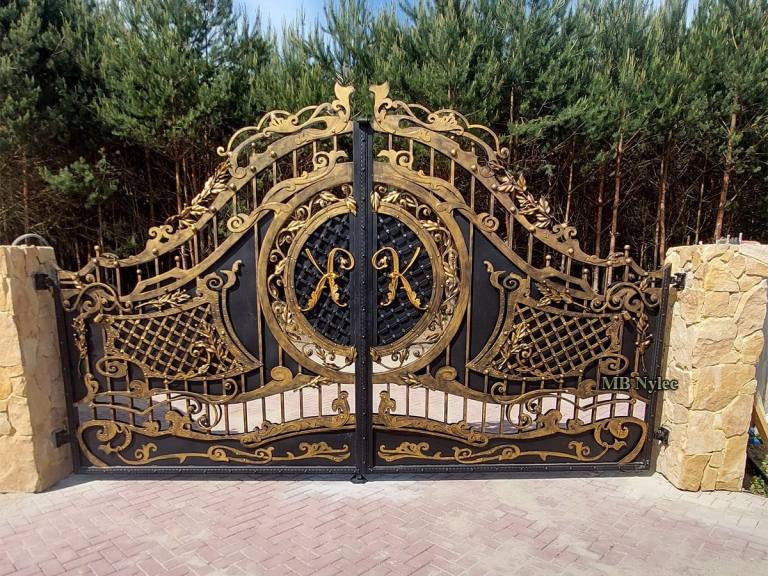


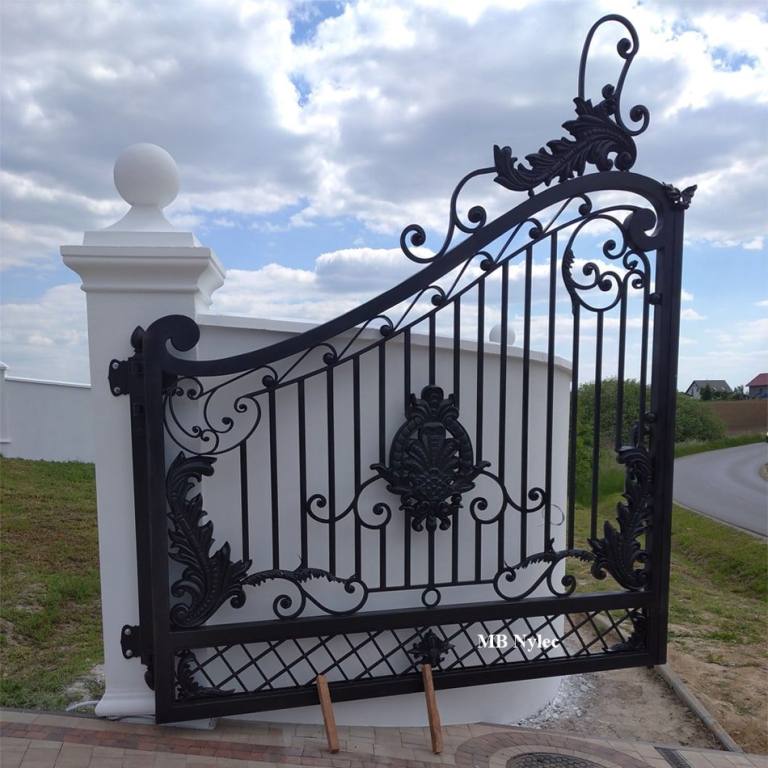


Traditional, solid, oriental and sculpted gates
Openwork gates are the classic of the craft. Manor gates are elegant and restrained; baroque gates fit palace ornament into an ordinary driveway; true palace gates, often with a fixed crown, can reach six metres (20 ft) in height. Browse our traditional wrought iron gates, from the Art Nouveau gate BP111 to the Gothic gate BP164.
A full gate hides the drive completely behind a forged pattern. It is built in several layers, one- or two-sided, and designed so that it survives hot-dip galvanizing without warping, which is harder than it sounds. See our solid wrought iron privacy gates, such as the arched-portal gate BP83.
For something truly unusual, our oriental-style gates bring gilded crests and crowns, while our sculpted gates hold life-size deer, wolves and oaks forged in three dimensions.
Ordering a gate from the USA, the UK or elsewhere
Send us a photo of your entrance and the width and height of the opening. We prepare a drawing, agree the finish with you, then forge, galvanize and paint the gate in our workshop. Our own teams install across Europe; for overseas clients we ship the gate securely packed, with drawings and support for a local installer.
What sets a forged iron gate apart
Forged iron gates are the most prestigious way into a property and one of the most demanding steel structures in private architecture. They are not a system product or a light screen hung on ready-made posts, but massive structures designed for a specific opening, ground conditions, slope and style of house.
The difference between a professional forged gate and a standard metal gate is visible not only in the design but above all in the structure. A typical gate from a home-improvement store often weighs 70–120 kg (150–260 lb). A genuine premium driveway gate starts at several hundred kilograms, and for large residential projects it can exceed a tonne. That weight comes from solid steel sections, the right material thickness and a frame designed for many years of use.
We do not build light decorative frames. We design gates that keep their geometry, smooth operation and stiffness after twenty years. The right mass, proper bracing and carefully planned load paths mean the leaves do not sag, twist or drift out of line, however often they are used.
A gate designed around the house
A well-designed driveway gate is more than a piece of hardware: it is the axis of the whole entrance. Its proportions have to relate to the height of the fence, the width of the piers, the line of the facade and the scale of the building. On larger properties the gate often marks the main sight line leading to the front door, so its height, the rhythm of its detail and the division of the leaves are designed together with the architecture, never in isolation.
Blacksmith wrought iron gates: quality you can check
The quality of blacksmith wrought iron gates shows in the details of their construction, not in a photograph. In our workshop the ornaments are forged by hand from solid stock rather than assembled from ready-made pressed or moulded decorations. The leaves are built from solid steel sections, with bracing matched to the weight and width of the gate, so they do not drop or lose their shape over the years.
Every gate is hot-dip galvanized, and our outdoor products come with a guarantee on their corrosion protection. The design always starts from the property itself: the width of the opening, the piers, the fence and the style of the house. The difference is easiest to see in person, which is why we invite clients to our showroom in Dębica, where forged gates stand next to ordinary metal gates.
Double swing gates: hinges, piers and foundations
Double swing gates are the most stately form of entrance. Two symmetrical leaves create a monumental composition and work beautifully with substantial gate piers. With heavy gates, the design of the hinges and the way they are anchored in the piers are critical: the axis of rotation must allow for the real weight of each leaf, wind loads and the dynamic forces of daily use. The pier foundations have to be properly reinforced and tied into the fence structure, so they can resist twisting without leaning out of plumb.
Sliding and cantilever gates
Sliding gates call for even greater precision. In a cantilever system the whole weight of the leaf and its counterweight rests on carriages anchored in the foundation. The length of the counterweight is structural, not decorative: it keeps the gate stable and spreads the forces correctly. Too short a counterweight overloads the motor; too light a frame leads to vibration and jerky movement. The design of the bottom frame, the guides and the cross-bracing decides whether a sliding gate will run smoothly for years.
Whichever way it opens, every gate in this section is a full premium driveway gate, designed as a heavy, stable structure built for decades of use.
Almost every design can be built as a double swing gate or a sliding gate, including cantilever sliders that need no track across the drive. All our gates are prepared for automatic openers, and we size hinges, posts and motors for the real weight of the ironwork.
Gates that will not warp in the zinc bath
Many products sold as metal gates are light systems made of thin-walled hollow tube. The real differences lie in load capacity, weight and the way the parts are joined. In a professional steel gate what counts are solid sections, the right thickness, sound welds and an allowance for the heat distortion that occurs during hot-dip galvanizing. The structure must be designed from the outset to be dipped in molten zinc, which takes experience and knowledge of materials; mistakes at this stage lead to twisting, permanent deformation and leaves that no longer hang true.
Foundations, automation and a long life
A professional entrance gate is not only the leaf. The foundations and the way the piers are set are just as important. Heavy gates need reinforced footings tied into the fence structure, so that the horizontal forces and the twisting moments created by heavy leaves and wind pressure are carried safely into the ground.
Automatic openers are chosen for the real weight of the gate, with a safety margin. A motor that is too weak wears out quickly and fails. On premium projects every component, from the hinges to the sliding carriages, is selected by calculation, not just from a catalogue. Forged iron gates are an investment in durability, security and prestige: a well-made entrance gate keeps its proportions, its smooth action and its stability for decades, whatever the trends.
Wrought iron gate FAQ
Is a modern wrought iron gate really wrought iron?
Historic wrought iron was a fibrous, low-carbon iron that is no longer made commercially. Today the term means a gate hand-forged from solid mild steel in the blacksmith tradition, which is exactly what we make, as opposed to gates welded from hollow tube with pressed decorations.
How long will a hand-forged gate last?
With hot-dip galvanizing under the paint, a well-built gate lasts for decades; the paint may need refreshing from time to time, but the steel stays sound.
Can you design a gate to match my house?
Yes. We often take motifs from the architecture, railings or window grilles of the house, so the gate looks as if it had always belonged there.
What does a forged gate actually mean?
It is a gate whose parts are shaped by hot forging: the blacksmith heats the steel in the fire and forms it with a hammer, instead of assembling the gate from ready-made tubes and stamped ornaments. That is what gives the detail its depth and the structure its strength.
Which is better, a sliding gate or a double swing gate?
It depends on the property. A double swing gate is the most stately, but it needs room for the leaves to open. A sliding gate is better for a short drive or a slope. We make both as forged gates to exactly the same standard.
Do forged gates rust?
Not when they are hot-dip galvanized. Every gate we make is galvanized before painting, and we guarantee the corrosion protection.
Complete the entrance with matching wrought iron wickets, wrought iron fences and forged pillars. Ready compositions of a gate, a wicket and fence panels drawn as one design are shown among our wrought iron gate sets, and the same ornament can continue on the front of the house in wrought iron doors. For an overview of the whole range in one place, see our metal gates and fences.