
Wrought Iron Fences
A wrought iron fence frames a property for generations. We hand-forge ornamental fence panels for houses, manors, palaces and parks: classic designs with vertical bars and finials, richly scrolled palace fencing, Art Nouveau and rococo patterns, oriental luxury, modern geometric lines and full privacy fences.
Every pattern below can be adapted, and we can draw a new one from a sketch or a photo, or reconstruct a historic fence.
Our fence designs


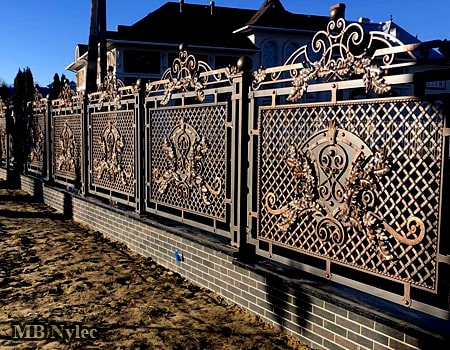

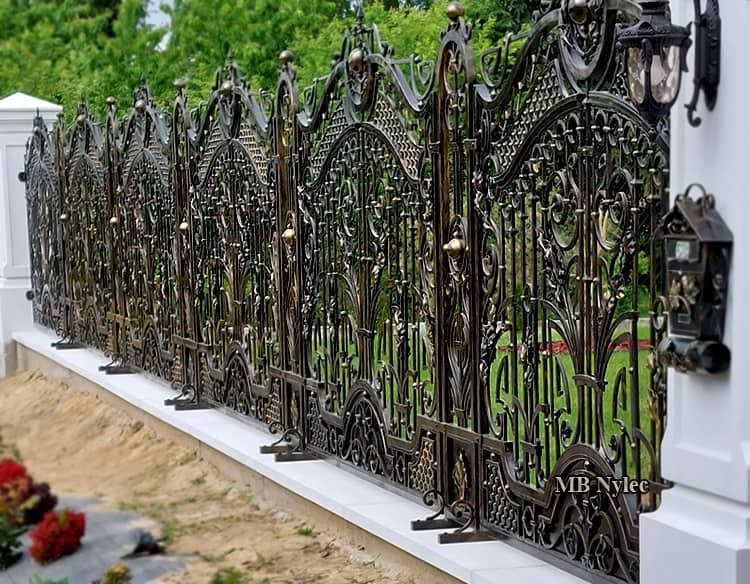
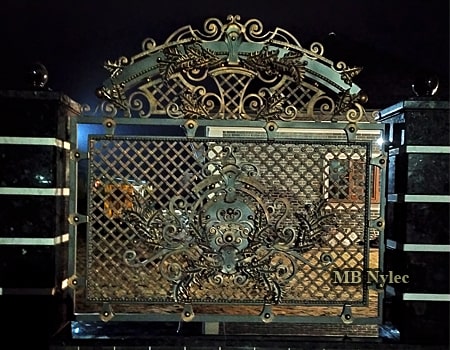


Fences are one of the most important parts of our work. Each forged fence is made in our workshop by experienced blacksmiths and metal artists, using solutions, materials and techniques that you will not find in standard fencing, and we install them across Europe and ship them worldwide.
Openwork posts and matching gates
Our most striking fences replace some or all of the brick or concrete piers with intricately forged openwork posts. The fence then reads as one continuous piece of ironwork rather than a row of separate panels, and the posts themselves become decoration. See our openwork forged columns for examples.
A fence looks best when the driveway gate and the pedestrian gate share its pattern. We design the whole run together, from the wrought iron gate to the last panel, and we can extend any gate design into fencing.
Forged fences: craftsmanship and design
We make metal fences to measure, paying attention to proportion, detail and the durability of the whole structure. Any design can be adapted to your needs, and if nothing in our gallery fits, we will draw a completely new proposal from your notes, a sketch or a photo. We also reconstruct historic fences, keeping the character and style of the original.
A forged fence is the most demanding kind of steel fence to make. Designing one takes engineering knowledge, a feel for proportion and years of experience in artistic blacksmithing. It is the combination of serious corrosion protection and hand-finished detail that turns a forged fence into a showpiece of the property rather than a purely practical barrier. When you entrust a fence to us, you get a design matched to your house and workmanship that will still look good decades from now.
Types of wrought iron fences
Every fence we make is built to the same standard, but the range of types is wide. You do not have to choose on your own: tell us what you need, and we will suggest the fence that suits your property best.
Classic openwork fences
Openwork fences are the most classic form of wrought iron fencing. A light infill of bars, scrolls, leaves and forged ornaments keeps the house and garden in view while clearly marking the boundary. This is the most popular choice for traditional, manor and palace-style homes, especially where the facade and the garden should stay visible from the street. Our manor-style fence BP54 and classic mansion fence BP211 are typical examples of a manor fence of this kind.
Full privacy fences
Full metal fences are ideal for anyone who values privacy. They hide the view of the property completely or to a large extent, and they are usually far more complex than openwork fences because they are built in layers. They come in two versions: one-sided and two-sided.
In a one-sided fence the decorative pattern faces the street, and on the garden side there is a screening element, usually steel sheet. Most of our clients, however, choose two-sided fences. These have a much thicker frame and weigh about twice as much: the steel sheet sits inside the structure and the ornament is built on both sides. They are demanding to make, but they look superb from both directions and give complete privacy, as in our full wrought iron fence BP228 or the full fanciful property fence BP239.
Oriental fences
Oriental wrought iron fences are rarely seen in Europe, mainly because they take far more work than traditional fencing. They repay it with an extraordinary look and a design you will not find anywhere else. They have the heaviest construction of all our fences, and their ornaments, gilded acanthus, crests and crowns, are not used in any other type. We are one of the few workshops in Europe that make such exclusive fences. Similar fences are produced in Asia, but our goal is workmanship and durability suited to European and North American climates. See, for example, the oriental palace fence BP207.
Nature and hunting fences
This is a completely different kind of forged fence, one that we invented and in which we specialise. These fences were conceived, designed and developed in our own workshop for people who want a style connected with nature. They show all kinds of plant and animal scenes, most often in the form of trees made entirely of steel, with deer, herons or wild boar among the branches. More of these artistic fences can be found among our sculpted metal art gates and fences.
Continuous fences without panels
Besides light openwork panels and full privacy fences, one of our most striking solutions is a continuous fence, which gives the impression of a single unbroken line without the usual division into panels and masonry piers. We achieve this with intricately forged openwork posts that look elegant without overwhelming the front of the plot.
The fence then looks far more unified and the front of the property gains a strong, refined character. Such a fence needs careful design and the right structure, because the whole run has to stay stable over a long distance; done properly, the effect is exceptional and much less common. Examples are our continuous forged fence BP273 and the continuous palace fence BP268.
Modern and contemporary wrought iron fences
More and more clients are looking for a modern metal fence that is not just another mesh panel. A contemporary wrought iron fence relies on clean lines, geometry and balanced proportions, with no excess ornament but with details that set it apart from mass-produced fencing at a glance. The form is calmer than in classic fences, while the structure remains just as solid and carefully finished.
Modern fences suit houses with contemporary architecture, simple volumes and large windows, as well as facades that combine stone, timber and steel. Each project is made to measure, so a modern design can be matched to the plinth, the posts and the driveway gate. Good examples of modern wrought iron fence designs are the geometric fence BP217, the massive rail-style fence BP221, the fence with an oval motif BP244 and the modern vintage fence BP240, which blends a modern form with a classic accent.
Choosing a fence for your house: style, structure and privacy
People choose wrought iron fences when they want solid protection for their property together with a look that genuinely adds to its value. A fence does far more than mark the boundary of a plot. It creates the first impression, organises the space and frames the driveway, the entrance and the whole front of the house.
A well-designed front fence should suit both the architecture and everyday use. A fence along a wide plot is planned differently from one on a short frontage close to the road. In one case a light openwork design is best; in another the client needs more screening and calm, so a fuller solution is chosen. Sometimes the key is to keep the view open, because the garden and the facade are meant to be seen and to work together.
Height matters too. A fence that is too low may not feel secure, while one that is too high can visually close the house in and rob it of lightness. When designing, it is worth deciding not only the height but also whether the top line should be level, stepped or gently varied, which looks natural where the ground slopes.
The level of privacy is just as important. Full fences hide the driveway and the area around the house; openwork fences offer lightness and elegant transparency. Very often the best result is a mixed solution, planned so that the fence stays open in one place and screens in another. It is then practical, looks natural and never feels like a solid wall, even where privacy is needed.
In the end two things count most: your own taste, because you should choose a fence you will enjoy living with, and the way it suits the property. Send us photos of the house with a few notes on the size and layout of the garden, and we will propose the right fence. For every fence we can also design a matching wrought iron gate and wicket, so the whole frontage forms one composition.
Fences for residences, manors and large estates
Fences for residences, manor houses and large estates are a group of their own. Here the fence is part of the architecture of the whole site: it has to suit the scale of the building, the length of the frontage and the character of the surroundings, without overpowering the facade.
Estate fences are usually our most exclusive commissions, taller and heavier than typical garden fences, with stronger frames, richer infill and elaborate crests. The details, scrolls, leaves, forged bar ends and coats of arms, are worked so that they look good from a distance and up close. The ornament is rich but orderly and consistent with the driveway gate and the wicket, because a decorative fence must never look overloaded.
Examples include the massive park and palace fence, the Royal palace fence BP209, the palace park fence with brass BP223 and the residence fence BP268. Any of them can be adapted to a particular property by changing the height, the panel spacing or the density of ornament, or redesigned from scratch.
Fence designs, fence panels and custom projects
A fence pattern should be matched to the house just as carefully as the gate or the facade. The best effect comes from consistency: rhythm, repetition and well-placed accents. A pattern that is too modest may not suit a building with a strong form and a tall facade, while an over-decorative design can dominate the space if the house is minimalist.
In practice, the biggest difference lies in details you do not notice at first glance: the balance of the infill, the proportions of the frame, the spacing of the uprights, and whether a panel looks elegant from afar and still holds up close by. Fences are often seen at arm’s length, at the entrance, the driveway and the gate, so quality shows in the details.
Forged fence panels are the basic element of most projects, so their construction is crucial for durability and appearance. Well-made panels keep their geometry, never look flimsy and stay attractive season after season. What matters is a stiff frame, sound joints and careful finishing of the places that are often the weakest point of mass-produced fencing. All the panels along a run must look consistent; only then does the fence look orderly and high-end.
Made-to-measure fences have one more big advantage: the width of each panel can follow the layout of the plot. This is crucial where the ground is not level, where there are changes in height, or where the frontage needs non-standard solutions, including wrought iron fence designs for brick walls and between brick piers. The result looks deliberate, not like a set of parts forced into place.
After many years in business we have a large library of fence patterns and a gallery of completed work. Any design can be made exactly as shown or modified in selected parts; just tell us which elements should stay and which should be adapted to the style of the building, the layout of the property or the privacy you need. If you cannot find what you are looking for, describe your ideal fence and we will analyse it, propose ready solutions or design a new pattern for you.
Our team includes not only experienced blacksmiths and metal artists but also people with broad artistic talent. That is why every fence we design can be made exactly as drawn. Only someone who combines blacksmithing skills with drawing and design ability can create a pattern that can be forged in full, and this is one of the reasons our fences stand out. Our drawings show the client precisely what they will receive, without unnecessary clutter.
Hot-dip galvanizing: forged fences that do not rust
With any metal fence, what matters most is how the steel will behave after years outdoors. Even the best design loses its value if the fence quickly shows rust, discoloration or flaking paint, so corrosion protection is crucial for the durability and appearance of the whole investment.
Hot-dip galvanizing is one of the most effective ways to protect steel. It prepares the fence for the weather and helps it cope far better with moisture, temperature changes and everyday wear. In practice this means years of peace of mind, because the fence does not need constant touch-ups and its details keep their good looks for longer.
Many fence makers avoid this system because it is demanding and adds a production step. For us, quality comes first, so all our forged products intended for outdoor use come with a guarantee on their corrosion protection. The protection also has to be thorough: in a forged fence it is not only the large surfaces that count, but the joints, the details and the places most exposed to water and dirt.
After forging, every panel is hot-dip galvanized, then primed and painted, with patina or gilding if you wish. We measure, deliver and install in Europe, and ship fence panels with fixing details to the USA, the UK and further afield.
From design to installation
As fence makers we handle the whole project, from the first sketch to installation on site. We start with a conversation and photos of the house, then choose a pattern or prepare an individual design, a drawing that shows exactly how the finished fence will look. Only after it is approved do we start work in the forge.
All the elements are made in our workshop in Dębica, Poland: hand-forged details, fence panels, openwork posts, gates and wickets. Each fence is made to measure, allowing for slopes, the height of the plinth and the spacing of the posts, and is then hot-dip galvanized. We deliver and install fences across Europe and ship them overseas with fixing details, so you get a complete, lockable frontage without having to coordinate several contractors.
That is what places our metal fences in the premium segment, not by name but by workmanship: solid steel, hand-forged details, hot-dip galvanizing and care that is visible up close.
How we prepare a quote
A fence is an investment for decades, so it is natural to ask what a forged fence involves. The quote depends on several factors that really affect the amount of work: the size of the panels, the complexity of the pattern, the density of the infill, the type of fence (openwork or full), the finish and the visual effect you want.
Whether the fence should be light or more massive also makes a difference, as do non-standard solutions such as continuous fences without panels. The best way is a quote based on your actual dimensions and expectations, because only then can we propose a fence that suits the style of the house and the role it is meant to play.
The choice of maker matters too. A forged fence manufacturer should understand both the aesthetic and the structural side, because the two have to work together. We make sure that each design is consistent with the architecture of the house and that the finished fence is durable, refined and thought through in every detail.
Forged fences versus ordinary metal fences
The difference is huge, even though the terms partly overlap. A forged fence is also made of metal, but unlike metal fencing in general, its construction is far more complex and time-consuming. Most metal fences today are simple welded mesh panels and mass-market products designed for fast production in large quantities. They have nothing in common with our craft, even though simple metal fences are often wrongly called wrought iron.
Our fences differ from them in their design, their weight (forged fences are much heavier than mass-produced ones), their materials, their technology and workmanship, and the way they are protected. All of this comes down to one thing: a blacksmith fence of our making underlines the prestige of the building it surrounds and draws attention with its looks.
Is a wrought iron fence the best choice?
Yes, provided it is designed and made to the highest standard, and its uses are wide. Forged fences can be complete structures built from forged panels, or an exclusive addition to a stately masonry wall. Beautiful forged panels are also used as a decorative crown on a high plinth or wall, where the ironwork plays a purely ornamental role.
We cultivate the old tradition of exclusive fences that is still alive in many European countries, especially France, where the culture of forged fencing has survived intact and nobody would call a simple metal fence wrought iron. Our range also goes beyond European traditions: we make exclusive oriental-style fences with roots in the culture of the Far East. We keep developing our fences and other products so that we remain among the best in the world in this field.
See our fences in our showroom
At our workshop in Dębica we have built a large showroom where you can see our forged fences in person, along with many other works of artistic blacksmithing. It is one of the largest displays of its kind in Poland, and every item shown there can also be bought. Our metal sculptures attract particular attention.
The main purpose of the showroom is to let you compare the quality of our fences with other products on the market. We are confident that after such a comparison you will see a very big difference.
Fence FAQ
How tall can a wrought iron fence be?
Garden fences are typically 1.2–1.8 m (4–6 ft) high; park and palace fences often exceed 2 m (6.5 ft). We advise on proportions so the fence suits both the house and the plot.
Can a fence sit on top of an existing wall?
Yes. Many of our panels are designed for low walls or high foundations, and we can add a forged superstructure to a wall you already have.
Do you make privacy fences?
Yes. Full fences combine a forged pattern with a screening sheet, and partly screened designs hide the view only at eye level.
Do you install fences outside Poland?
Yes. We install fences across Europe and ship them to the USA, the UK and further afield with full fixing details. Distance makes no difference to us; we take care of everything needed for you to close and lock your property, and we always propose a matching gate so the whole project looks consistent.
Do wrought iron fences rust?
Ours do not. Every fence is hot-dip galvanized before painting, and all our outdoor forged products come with a guarantee on their corrosion protection.
Are the designs limited to your gallery?
Not at all. The gallery only shows what we have made so far and what we are capable of. Any model can be modified, and we also work from clients’ photos, sketches or even a verbal description.
Is a rod iron fence the same as a wrought iron fence?
Yes, rod iron is simply a common spelling of wrought iron. Today both names describe ornamental steel fencing; ours is hand-forged from solid steel bar and then galvanized, which makes it far stronger and longer-lasting than light welded panels sold under the same name.