
Wrought Iron Garden Swings
A garden swing is where people end up when the work is done: an unhurried seat for two or three, gently rocking in the shade. We hand-forge canopy swings with solid steel frames, wooden or forged seats and roofs of polycarbonate or sheet steel, in styles from restrained classic to full glamour with gold leaf.
Our garden swing designs
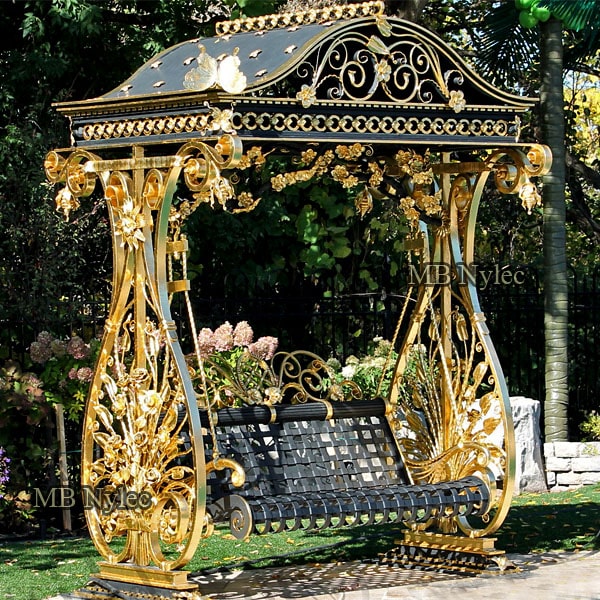


Each swing on this page can be copied, adapted or used as a starting point for an entirely new design of your own.
What makes a forged swing different
Mass-produced patio swings are usually bent from thin tube and bolted together. Ours have frames forged and riveted from solid bar, which is why they do not wobble, creak or rust through after a few seasons. The seat hangs from heavy-duty fittings rated well beyond the weight of three adults.
Choose a seat in hardwood slats or forged steel lattice, and a roof in solid polycarbonate, corrugated or smooth sheet steel. Every frame is hot-dip galvanized and then painted; graphite, black, ivory and ecru are popular, and details can be picked out in gold or bronze.
Garden swings: which material lasts?
Garden swings are made of wood, metal or various plastics. Plastic and wooden swings are usually among the least expensive, but also the least durable. A swing is an outdoor piece, constantly exposed to the weather, and swings made wholly or partly of plastic are delicate and light: they are easily damaged by knocks and rain, fade and crumble in sun and frost, and rarely last more than a season or two.
Wooden swings
Wooden swings fare a little better, but only a little. Wood can be strong if the right species is used and properly treated, and it needs to be treated again after every season. Unfortunately most wooden swings are made of the least expensive softwoods, which are not very resistant and quickly decay and rot; they look lovely only at the very beginning. Swings made of high-quality hardwood, on the other hand, are very demanding to make. That is why the most durable category of garden swings is well-made metal swings.
Metal swings
Metal is widely used for swings and many other garden products, but that alone does not mean quality. Much depends on which metal is used, how thick it is, how it is joined and how it is protected. It is easy to find metal products so light and flimsy that they literally fall apart after a short time; they seem a bargain, but they are really very expensive, because you soon have to buy them again. A sensible purchase is a swing made of thick, solid metal, preferably steel. Because of their weight, individual design and the work involved, such swings are hardly ever found in stores; they are usually made to order, in traditional or modern designs, and the finest of all are forged swings.
Forged swings
Forged swings are the most beautiful, durable and best-made garden swings there are, provided they come from a workshop with high standards, knowledge and tradition. That is exactly what we make. An average forged garden swing from our workshop weighs several hundred kilograms, and making one usually takes at least two months, sometimes much longer. Every element is thought through in terms of construction, shape, look and quality, and every detail can be discussed with you, because besides our own designs we make modifications and designs supplied by clients. Some of our swings also include elements of artistic metalwork, and you can compare their quality with other swings in our showroom in Dębica, alongside garden benches, railings, fences and many other forged pieces.
Lighting and matching garden pieces
When we design a swing we also think about extras that make it more useful. Some models are fitted with forged garden lamps, which add to the look and the atmosphere of the garden, and the lights can be switched on automatically by a motion sensor as someone approaches; the brightness, and optionally the colour, can be set individually, as on our garden swing with lamps AH5. We can also make matching pieces to stand nearby, such as garden grills, gazebos and door canopies, all in one style.
Metal swings with a roof, small and large
Every swing we make has a hot-dip galvanized steel frame and a roof of sheet steel, polycarbonate or glass. The seat can be wood, as in models AH4 and AH7, or entirely steel, as in AH5 with its built-in lanterns. The smallest models, such as AH8, fit beside a terrace, while large glamour swings like AH1 become the centrepiece of the garden. We match the width of the seat to the number of people and the height of the frame to the place where the swing will stand.
A swing designed for its place
We design every swing for the spot where it will stand: under a tree, beside a pond, on a terrace or in a gazebo-like corner of the garden. The roof can follow the line of the house, the seat can be wider for a family, and the colour and ornament can match the gate, the benches or the lamps so that the swing looks as if it had always belonged there.
Swing FAQ
Does a garden swing need to be anchored?
Our swings are heavy enough to stand on level paving or a lawn, but we recommend fixing the feet to the ground in exposed, windy gardens.
Can you add lamps or a canopy curtain?
Yes. Forged lanterns can be mounted on the frame, and rails for side curtains or mosquito nets can be built in.
How many people can sit on a forged swing?
Most of our swings seat two or three adults, and wider seats can be made for four. The frame and the fittings are designed with a large safety margin over the weight of the people using them.
How much space does a garden swing need?
Allow the footprint of the frame plus about a metre (3 ft) in front and behind so that the seat can swing freely. Most of our swings are 2 to 2.5 m (6.5 to 8 ft) wide; we can make a narrower or wider frame to fit your terrace.
Can a forged swing be moved later?
Yes. Swings standing on paving or a lawn can be moved with a few people or a small lifting device, and anchored swings can be unbolted and set up again elsewhere.