Wrought Iron Door Canopies
A canopy over the front door is the first piece of ironwork every visitor sees, and it does a real job: it keeps rain off the step, the door and whoever is looking for their keys. We hand-forge wrought iron door canopies and porch roofs for houses, manors and city residences, glazed with glass or solid polycarbonate.
Our door canopy designs


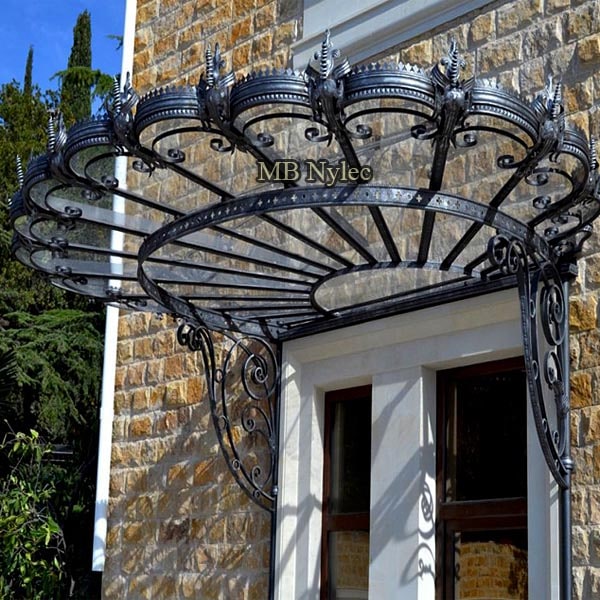


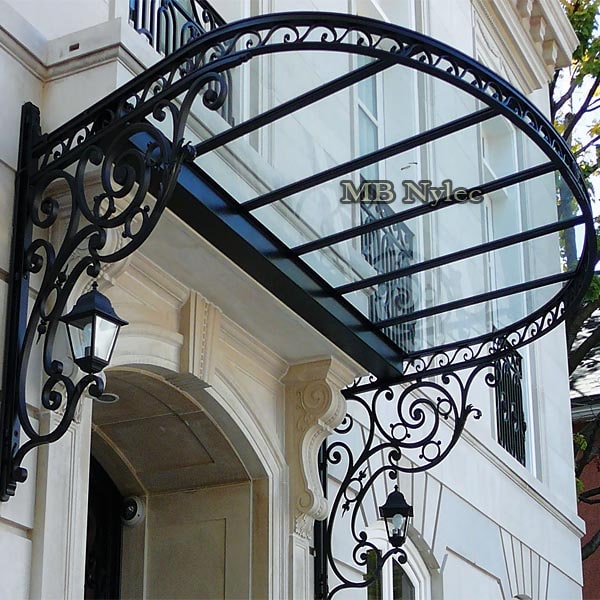


The designs above run from light, airy arches to French-style marquises, shell-shaped canopies and massive Art Nouveau pieces with built-in lanterns. Every one was made for a specific facade.
Roof, drainage and fixing
Laminated safety glass looks crisp and stays clear for decades, which is why it is the classic choice for French-style canopies. Solid polycarbonate is lighter, practically unbreakable and available clear or milky, so it diffuses daylight and hides leaves lying on top. We advise on the better option for your entrance.
Water has to go somewhere. Depending on the design we fit hidden gutters, rain chains or decorative gargoyles, and French canopies slope back towards the wall, where a gutter collects the rain. Brackets are anchored into the structural wall, and wide canopies over terraces are carried on forged columns.
We glaze door canopies with laminated glass or with polycarbonate, clear, milky or smoked. Glass does not hide the facade and shows the forged ornament best, as on the French-style canopy AD3, the shell-shaped canopy AD11 or the corner canopy with lions AD13. Polycarbonate is lighter and works well on larger roofs, such as the shell canopy with dragon-head gargoyles AD12.
Why a front door needs a canopy
How important a door canopy is depends on the building. If every entrance is set deep under the structure of the house, for example beneath a large balcony, a canopy adds extra protection but is not essential. In most houses, however, the front door sits in a shallow recess or flush with the facade, so rain and sun hit it directly: people get wet looking for their keys, water can find its way inside, and doors heated by the sun work and may crack.
Any door exposed to the weather wears out much faster than a sheltered one, which is why a door canopy matters: it protects. It can also have side screens against the wind. A canopy is most important when the door is beautiful and valuable, and solid oak doors are a good example: without protection, driving rain can start to rot them within five to eight years, and snow resting against them in winter speeds that up. And if the door is beautiful, its canopy should be beautiful too.
Decorative canopies made to measure
Most canopies over front doors are simple, light store-bought products. They suit many buildings and do their job, but on exclusive houses, beautiful doors and elegant residences they look out of place and can even spoil the facade. Such buildings call for decorative canopies, always made to order, because they must suit the architecture of the house and garden, the owner’s taste, the size of the door and the shape of the facade.
When designing a canopy we also consider the steps, landing or terrace in front of the entrance, because it often makes sense to extend the canopy so that it is comfortable to use and shelters a larger area. Sometimes the better solution is not a single canopy over the door but a roof over the whole terrace in front of the house. Every case is individual, and we will not only make your canopy but also advise on it and design it. Send us a photo of the entrance with the width of the door and the depth of the steps, and we will prepare a drawing of the canopy on your facade.
Why decorative canopies are made of metal
There is no other material for a beautiful decorative canopy than metal, and in the vast majority of cases that metal is steel. Store-bought canopies are often aluminium, but they are delicate and plain; canopies in copper, bronze or brass exist too, but they are rare, very demanding to make and not necessarily more beautiful than a fine steel canopy.
Like any product, a metal canopy can be a visual masterpiece or simply ugly. The steel is only the material; what really decides the result is how the canopy is built and the knowledge, talent, equipment and experience of the workshop. A company that makes plain metal canopies, even with decades of experience, will rarely build a beautiful ornamental one, because it is a different craft. We specialise in decorative metal canopies, and the most beautiful of them are forged.
Forged canopies, from palaces to today
Forged canopies are the most beautiful of all metal canopies. Historic residences and palaces had elegant canopies of often fairy-tale forms, and all of them were forged. We continue that tradition and have greatly improved its quality: old palace canopies were beautiful but corroded easily, whereas with hot-dip galvanizing corrosion is no longer a concern. Our canopies are made by our most experienced blacksmiths and often include elements of artistic metalwork.
Because a canopy is always fixed directly to the facade, it can carry many extras. The first are side screens, which shelter the entrance completely from wind and driving rain. The second are lamps, most often forged sconces, which can be fixed to the facade next to the canopy or built into it as one structure. If the canopy covers a terrace, it is worth adding forged railings around the terrace in the same pattern, and even repeating it in the fence and gate; we are happy to advise on that too. Lamps built into a canopy can be fitted with motion sensors, so the entrance lights up as you arrive.
Sizes, side screens and lamps
We match the width of the canopy to the door and the facade, and its projection to the steps and the landing. On request we add glass side screens against the wind, as on the canopy with glass side screens AD1, and lamps built into the brackets, as on the Art Nouveau canopy with lanterns AD8. For wide entrances and terraces we make large canopies carried on columns, like the wide terrace canopy AD9, which work as elegant wrought iron awnings over a whole seating area.
Canopies for every architectural style
For classic houses we draw French-style marquises and arched canopies with rich brackets; for Art Nouveau facades, flowing lines with leaves and built-in lanterns, as on AD8; for manors and palaces, massive canopies with crests and gilding; and for modern homes, clean forms like our modern vintage canopy AD10. Whatever the style, a vintage door canopy or a contemporary one is designed for a particular facade, so its proportions always suit the door and the windows around it.
Canopies over terraces and garage doors
Besides front-door canopies we make larger roofs over terraces, garage doors and side entrances, supported by brackets or forged columns. They protect furniture, cars and people from rain and sun, and when they share the pattern of the main door canopy and the railings, the whole facade gains a consistent, elegant look. We will gladly suggest the best solution for your house.
Canopy FAQ
How far can a wrought iron canopy project?
Wall-hung canopies usually project 90–150 cm (about 3–5 ft). Anything deeper is supported by posts or columns at the front.
Can you match our gate or railings?
Yes, we often repeat motifs from existing gates, balconies or window grilles so that the facade looks coherent.
Do you make wrought iron awnings for windows too?
Yes. Smaller canopies in the same style can be made over windows, balcony doors or a garage, so the whole facade shares one design.
Will snow damage a glass canopy?
No. We design the frame and choose the glass or polycarbonate for the snow load in your region, and the slope of the roof helps snow and rain run off.
Can a canopy be fitted to a timber or log house?
Yes. We design the brackets and fixings for the structure of the wall, whether it is masonry, timber frame or logs, so the canopy is anchored safely and the wall is not damaged by moisture around the fixings.
Door canopies are one part of our garden architecture range, alongside gazebos, swings and pergolas.