
Driveway and garden path lighting – placing lanterns and lamps

A well-lit driveway and path are about more than convenience and safety. After dark, lighting decides how the house looks from the street. A few well-placed lamps can bring out the gate, the planting and the facade, while poorly chosen ones dazzle, leave dark patches or make a garden feel like a parking lot. Here is how we approach lighting the entrance and the walk up to the house.
The driveway and the gate
At the driveway, tall lanterns on either side of the gate or on the fence pillars usually work best. They light the entrance from above, make it easier to maneuver a car and underline the formal character of the gate. A pair of lanterns flanking the drive gives a symmetrical, classic composition, while a single lantern by the wicket is enough where the entrance is more modest. Examples can be seen among our wrought iron lamp posts.
Lights mounted on fence pillars are another good option. Small forged lanterns on several pillars along the street light the sidewalk in front of the property, emphasize the rhythm of the panels and make the fence look as good at night as it does by day.
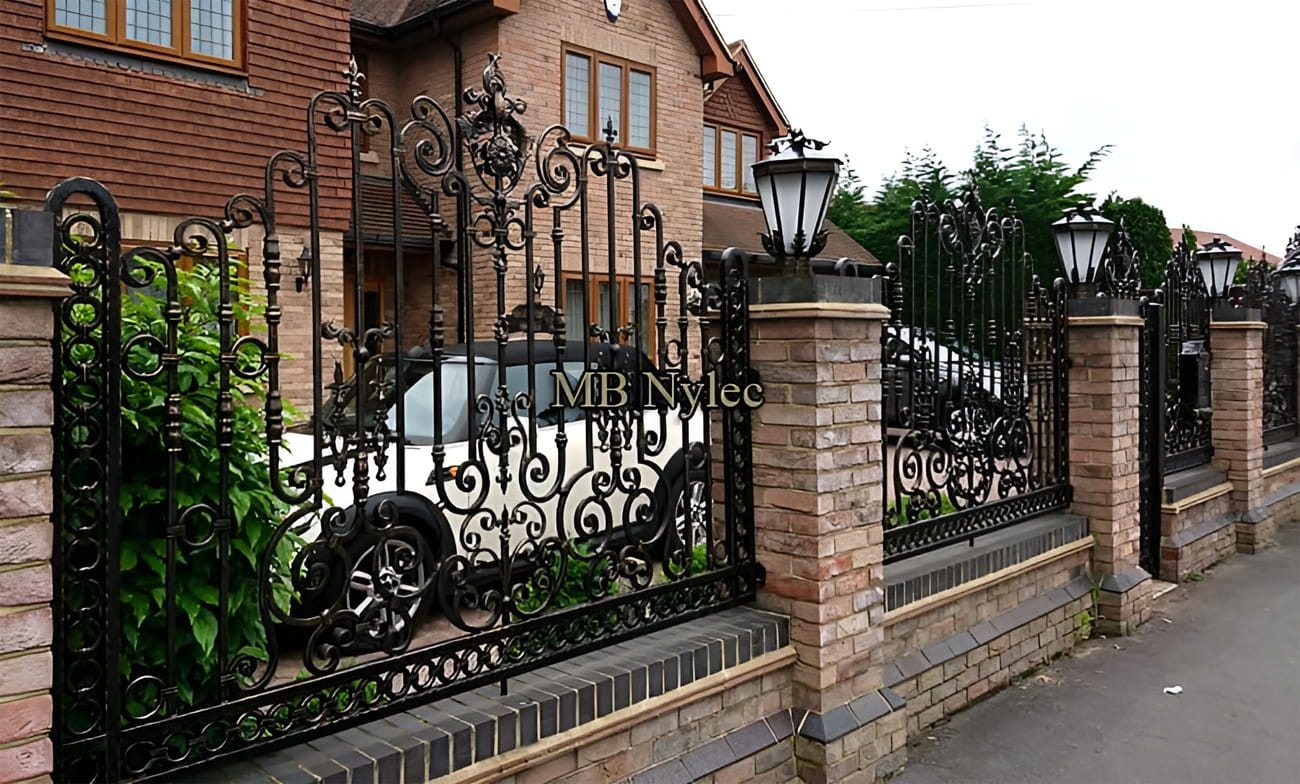
Along a longer driveway, further lanterns should be spaced evenly so that the pools of light meet instead of leaving dark gaps. Set them far enough back from the edge of the drive that a reversing car won’t clip them. Their height depends on the width of the driveway and the scale of the house: next to a modest home, lanterns that are too tall look like streetlights.
The path to the front door
The path from the gate to the door is best lit with low lamps placed along its edge. Light then falls on the paving and the steps rather than into the eyes of people walking. Lamps can alternate from one side of the path to the other or run along one side only, and their rhythm should follow the curves and steps. Places where the ground level changes need light most of all. Lamps of this kind are collected among our forged garden lamps.
Low lamps also have a decorative role. Placed by a flower bed or shrubs, they bring out the greenery in the evening, and beside a sculpture or a pond they create small, atmospheric scenes. Right at the front door, wall lights complete the picture, as we described in our article on designing a front entrance in one style.
Style, light and installation
Good lighting usually means several softer lamps rather than one very strong one. A single bright source dazzles and throws hard shadows, while a few gentle points lead the eye and reveal the shape of the garden. Think of the neighbors as well: position lamps so they don’t shine into anyone’s windows, and direct the light down onto the path and the plants rather than up into the sky.
Driveway lamps are seen in daylight just as much as the gate and fence, so they should speak the same language. Lanterns with forged brackets and leaves suit a richly ornamented gate, while plain posts with a clean-lined glass shade suit a modern fence. A warm light color fits a garden better than a cool one and does not distort the color of the planting or the facade.
Lighting is best planned before the pavers are laid and the lawn is seeded. Cables run underground in conduit, and each lantern needs a footing that will keep it upright for years. The wiring is done by an electrician, and we supply lamps ready for installation. Our forged lanterns and lamps are protected against corrosion the same way as our gates, so they can stand in the garden for decades.