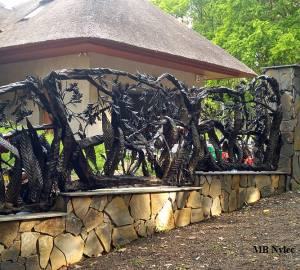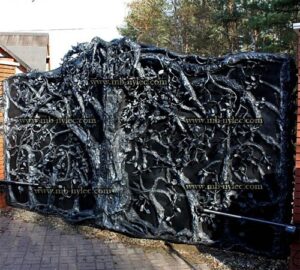
Forged Fence with Hand-Made Tree Branches (BM42)
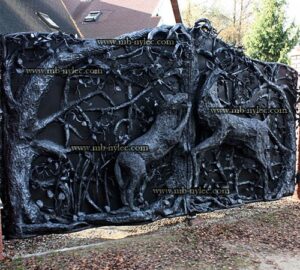
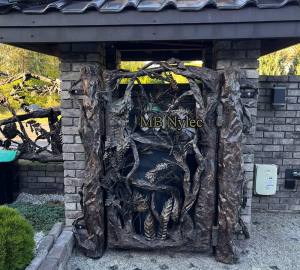
BM42 is a fence made of branches. Thick forged boughs twist along a stone wall, sprouting leaves, so the boundary looks as if it had grown there.


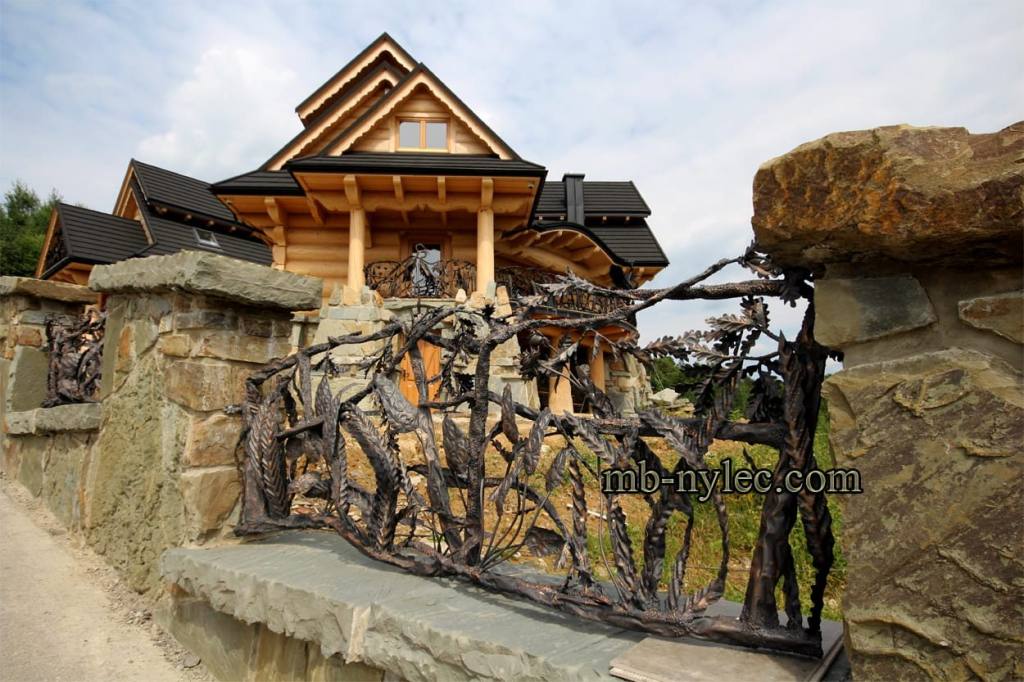


There are no animals in this one, although we can add them on request.
Shaped this way, steel sits beautifully with timber and stone, which makes the fence ideal for log houses, mountain-style homes and residences with large gardens.
No two spans alike
Every span is forged by hand, so each has its own character, and the whole fence is fully three-dimensional and hot-dip galvanized. We measure and install in Poland and abroad. For classic ornamental designs, see our wrought iron fences.


Steel that looks grown
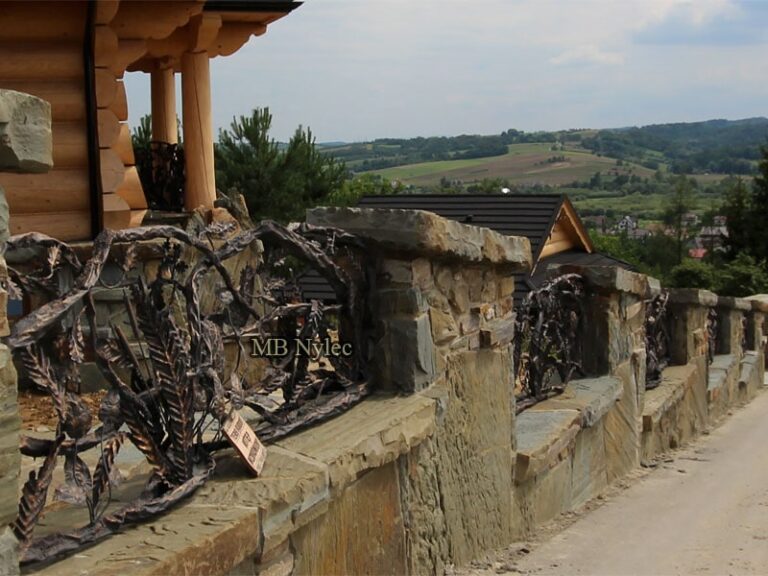
BM42 is a designer fence forged entirely by hand, with natural plant forms instead of bars and ornaments. Thick boughs twist along the stone wall, split into smaller branches and sprout leaves and grasses, so the boundary looks as if it had grown on the spot. There are no animals in this version, which keeps the focus on the plants, but birds or mammals can be added on request.
Made for log and mountain houses
The photos show the fence on a wall of split stone in front of a log house with a steep roof. Shaped this way, steel sits beautifully with timber and stone: the dark, bark-like finish of the branches echoes the colour of the logs, and the irregular lines answer the rough texture of the masonry. That is why BM42 is ideal for log houses, mountain-style homes, chalets and residences with large, natural gardens. The same look suits mountain homes far from Poland, from the Alps to Colorado and British Columbia.
How the branches are forged
Each bough starts as a heavy bar. It is heated and drawn out unevenly, so it tapers like a real branch, then bent, twisted and split at the forks. The surface is worked with hammers and chisels to imitate bark, and the leaves and grass blades are forged separately and welded on. No template is used for the overall shape; the blacksmith composes each span by eye, which is why no two spans are alike.
Structure hidden in the plants
A fence that looks free and natural still has to be strong. The thickest branches act as the load-bearing frame and are anchored into the wall or into the stone pillars, while the lighter growth fills the space between them. Because the elements are welded at many points, the whole span behaves like a rigid lattice, even though no straight bar is visible.
A fence that ages well
All parts are hot-dip galvanized before the final colour, so the branches will not rust even where water collects in the forks. The bark-like patina is applied by hand in several shades, and over the years it only gains character, much like real wood weathering. Maintenance is limited to an occasional check and, if needed, a touch-up of the colour on the most exposed parts.
Measured and installed by us
Every span is forged to the measured opening, whether between pillars or along a continuous wall. We measure and install in Poland and abroad, and for distant projects we ship the spans with drawings so that a local builder can prepare the wall and the fixings in advance. The fence can be continued with a matching gate and wicket made of the same branches.
You can see fences of this kind in person at our headquarters in Dębica, together with our other designer gates and sculptures.
Adding animals or a gate
BM42 is shown without animals, but the branches leave natural places for them. A heron can stand by the stream of grasses, a squirrel can run along a bough, an owl can sit in a fork, or a deer can appear in one of the wider spans. Each figure is forged separately and fixed into the branches, so it can also be added years after the fence was installed.
A driveway gate in the same style is built on a hidden steel frame clad with branches, so it opens like an ordinary gate while looking like part of the hedge of steel. Matching branches can also frame a letterbox, a house number or the lamp above the wicket, tying every element of the entrance together.
For a lighter version, the density of the branches can be reduced and the grasses left out, which lets more of the garden show through. For more privacy, the branches can be doubled in depth, creating a screen that hides the garden while still looking natural.
Before production we prepare a sketch of each span on a photo of the wall, so the owner can see how the branches will run and where the densest growth will be. Small changes, such as moving a heavy bough away from a window view, are easy at this stage and impossible once the steel is forged.