Forged Railing (BA36)
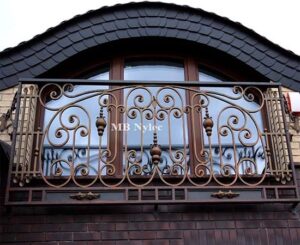
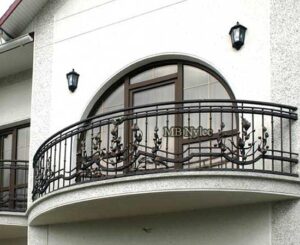
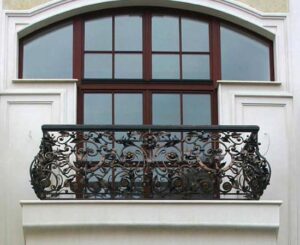
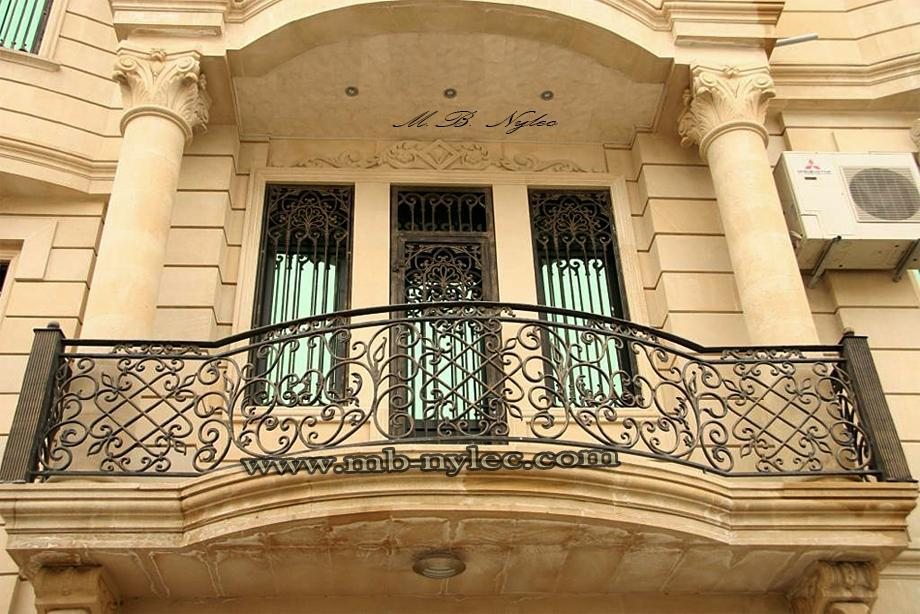
BA36 has a light, traditional openwork pattern, finished with massive wrought iron columns that give it an exclusive character. In the photo it curves across a balcony of carved stone.

It suits classic houses as well as mansions and palaces.
Following the arc of the balcony
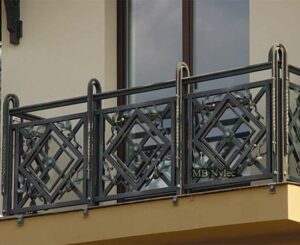
BA36 was fitted to a semicircular balcony, so the whole railing runs smoothly along the arc without random divisions. The top rail draws a steady line, and below it crossing bars, riveted joints and hand-shaped scrolls form a regular geometric pattern. Massive wrought iron columns at the ends frame the composition and give it an exclusive character, as the photo of the carved stone balcony between columns shows.
Riveting on a curve
Riveted lattice is traditional, but on a curved railing it is also demanding: every crossing sits at a slightly different angle, so the bars are bent to the radius first and the rivet holes drilled to match. Each segment was fitted individually, and the steel was shaped in the fire and refined by hand to keep the thickness, proportion and rhythm consistent along the whole arc.
Stiff along the whole curve
A railing on a curved balcony must stay rigid along its entire length. The lower part of BA36 stabilises the structure, while the central fields keep it orderly and symmetrical. The design suits classic houses as well as mansions and palaces, and further curved balconies are presented among our exterior balustrades.
Ornament serving the structure
The scrolls on BA36 are not plant forms; they come from the classical school of forging. Nothing here is accidental and there is no excess of detail: the ornament serves the structure, not the other way round. The elements are made in stages, from raw bar through shaping at high temperature to riveting and the final fitting of the whole balcony line, an approach typical of work in which craft and a conscious handling of steel matter most.